Cisco Connect 2026: What It Means for Your Organisation

22nd May 2026
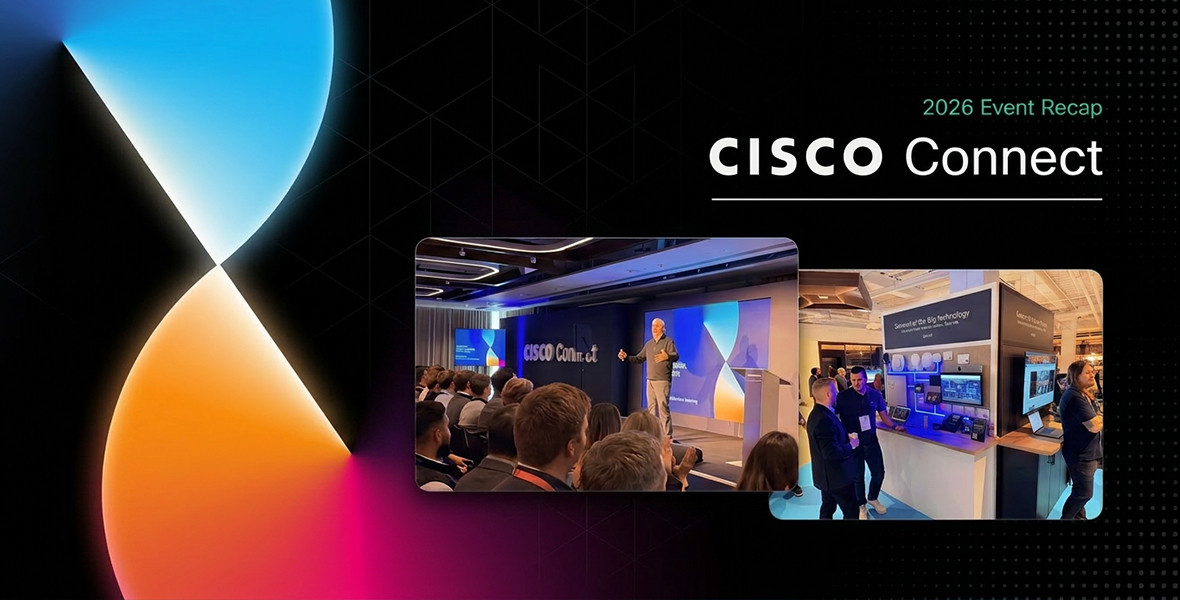
This week, the VCG team attended Cisco Connect 2026 in London - Cisco’s flagship UK & Ireland event - bringing together customers, partners and industry leaders to explore what’s next across AI, security, networking and modern work.
Across the sessions and partner discussions, one message came through clearly: the role of infrastructure is being fundamentally redefined for the AI era - and the conversation is shifting from technology to business outcomes.
Here are the key takeaways - and what they mean in practice for organisations.
1. “Fighting AI with AI” - the next evolution of cybersecurity
One of the most talked-about areas was the rise of agentic, AI-driven security. Cisco is part of Anthropic’s Project Glasswing, using the Claude Mythos model to:
Identify vulnerabilities at unprecedented speed
Analyse and prioritise threats
Accelerate patching and response
These models are already capable of finding thousands of high-severity vulnerabilities across major systems 4 - dramatically changing the threat landscape. The challenge is clear:
AI is lowering the barrier to entry for attackers
Threats are becoming faster, more automated, and more sophisticated
The response? Use AI defensively, at scale.
What it means for customer? Security operations must evolve from:
Reactive → Predictive
Manual → Automated
Siloed → Unified
This is where the concept of the “Agentic SOC” comes into play - using AI to continuously detect, prioritise and respond to threats in real time.
2. Reducing technical debt in the core infrastructure
A consistent message across sessions was that technical debt is now one of the biggest barriers to security, AI adoption and operational performance.
Outdated and fragmented environments are creating risk in ways that are often not fully understood:
Unsupported hardware and software
Siloed systems and tooling
Limited visibility across complex estates
These aren’t just operational challenges - they are direct contributors to cyber risk and reduced resilience. Linked to this is a renewed focus on the role of the network.
The network is becoming:
The foundation for AI workloads
The control plane for security enforcement
The platform for digital experience and collaboration
This is why we’re seeing a shift back to core infrastructure modernisation, not just as a refresh cycle, but as a strategic requirement.
What it means for customers:
Addressing technical debt is no longer optional - it’s essential to:
Reduce exposure to cyber threats
Enable AI and automation at scale
Improve performance, reliability and user experience
3. AIOps is here - and it’s ready
AIOps featured heavily across networking, data centre and operations discussions.
Cisco’s message was clear. The tools have arrived to operationalise AI across the datacentre and wider environment.
New capabilities are enabling:
Automated decision-making based on historical and real-time data
Predictive issue resolution
Greater visibility across complex estates
What it means for customers:
Organisations can now shift towards:
Proactive operations
Reduced manual effort
Faster resolution and improved service performance
4. Cisco IQ: AI-powered visibility and lifecycle management
One of the standout developments was the continued evolution of Cisco IQ.
While already available, new updates are coming later this year focused on enhancing its AI capabilities - particularly across large, complex Cisco estates.
These updates are designed to:
Analyse environments at scale
Provide smarter, contextual recommendations
Identify assets that are approaching or already outside of support
This last point is critical. In many organisations, a significant amount of technical debt sits hidden in:
Unsupported hardware
Out-of-date software
Unmanaged configurations
Cisco IQ is increasingly positioned to surface these risks proactively - helping organisations:
Take action earlier
Reduce exposure
Improve overall resilience
What it means for customers:
This is where the real value sits:
Not just visibility
But clear, actionable insight into where technical debt is building across the estate
5. Cisco Cloud Control
Cisco also introduced Cisco Cloud Control, which is set to be formally launched at Cisco Live in Las Vegas in the coming weeks.
While full details will follow at launch, the direction is already clear.
At its core, Cisco Cloud Control represents a move to bring together multiple management planes - across networking, security and operations - into a single, unified cloud-based interface.
This builds on existing capabilities such as Security Cloud Control, which already provides:
Centralised, cloud-native security management
Real-time visibility across environments
AI-driven insights and automation
The evolution with Cloud Control appears to be broader — extending this approach beyond security to deliver:
A single console for managing Cisco platforms and services
Unified visibility across network, security and application layers
AI-assisted operations, using both real-time and historical data to identify issues and recommend actions
The underlying challenge this is addressing is one most organisations will recognise:
Multiple tools
Multiple teams (NetOps, SecOps, CloudOps)
Limited shared visibility
By bringing these together, Cisco is aiming to:
Reduce operational complexity with a true single pane of glass
Improve collaboration across teams
Enable faster, more intelligent decision-making
What it means for customers:
As environments become more distributed and complex, the ability to manage everything through a single, intelligent control plane becomes increasingly valuable.
This is particularly important in the context of AI-driven environments, where:
Speed of response matters
Data needs to be interpreted at scale
Siloed tools slow everything down
👉 If you’d like to explore this further as it develops, Cisco’s Cloud Control experience will sit within their unified cloud platform: Explore Cisco Cloud Platform
6. Sovereignty and control are rising priorities
With increasing regulation and geopolitical complexity, data sovereignty is becoming a key design principle.
Cisco is investing heavily in:
Sovereign infrastructure options
Regionally controlled environments
Compliance-first architectures
This reflects growing customer demand for:
Control over where data resides
Confidence in how it is protected
7. The future workplace is platform-led and experience-driven
In modern work sessions, the focus shifted beyond tools to outcomes:
Employee wellbeing
Productivity
Seamless collaboration
Cisco’s vision is built around:
A secure network foundation
Collaboration platforms layered on top
AI-enhanced experiences
There was also increasing recognition that the workplace sits across multiple domains:
IT
HR
Facilities
Real estate
What this means overall
Across the event, and reinforced through partner discussions, a clear pattern emerged:
Security is driving infrastructure decisions
Technical debt is becoming visible - and actionable
AI is becoming part of the operating model - not an add-on
Platforms are replacing fragmented toolsets
Conversations are moving to the boardroom
Final thought
The biggest takeaway from Cisco Connect wasn’t a single announcement.
It was a shift in mindset:
Organisations that succeed in the AI era will be those that reduce complexity, modernise their core, and align infrastructure, security and operations around clear business outcomes.
Speak to us
If you’d like to explore any of the topics covered in more detail, or understand how Cisco’s latest innovations could apply to your organisation, get in touch with the VCG team.
As a Cisco partner with a growing set of accreditations across networking, security and collaboration, we work closely with customers to:
Reduce technical debt
Modernise infrastructure
Apply AI and automation in a practical, outcome-led way
You can also take a look at our recent updates on LinkedIn and our website to see the latest work we’re doing with Cisco technologies.