How AI Agents Change Network Traffic and Security

25th November 2026 | by Lee Byatt
4 Minute Read
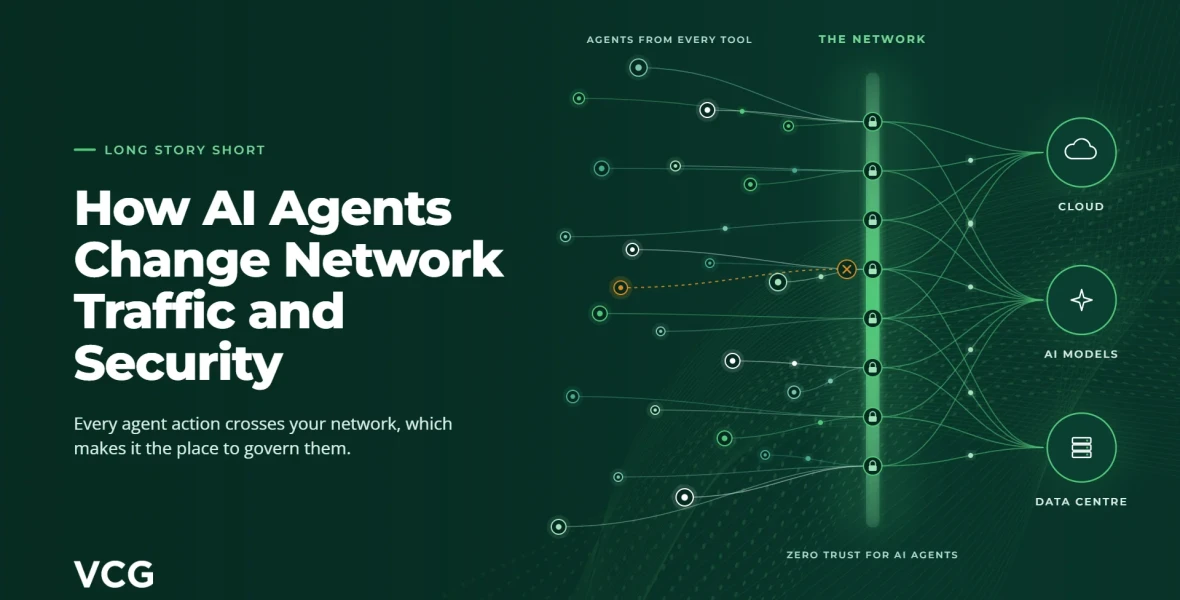
AI agents are fast becoming part of everyday work and home life, and they create far more network traffic than people. This article covers the numbers, the risks and why the network is where to govern them.
Long Story Short
Agents are spreading fast at work and at home, and each one can generate up to 450% more network traffic than a person doing the same task.
Cisco expects enterprise WAN traffic to grow 9x by 2035 with agentic AI, against 2.5x without it.
Agents need the right access to work freely, with every action authenticated and tracked.
Agents from different tools reach data across every platform. The network is the one thing they all depend on, so it is the one place to control them all.
Zero trust for agents means knowing every agent, authorising every action and stopping bad traffic at machine speed.
AI Agents and Network Traffic
AI agents are spreading fast. A third of organisations already run them across the business, and 97% expect to widen their use within two years. Cisco gave all 90,000 of its staff a personal agent this summer. At home, 14% of UK consumers already use AI agents to deal with brands and buy products.
Where a person doing a task pauses to read, think and go to meetings, an agent given the same goal keeps going: it plans, calls tools, checks results and tries again, overnight if needed. Cisco found a research agent generated about 450% more traffic than a person doing the same task, most of it spent talking to its AI model.
The traffic also travels further. One task can run from a branch laptop over Wi-Fi and SD-WAN to a SaaS model, then into public cloud and your data centre. 67% of IT leaders report more east-west traffic between internal systems because of AI.
How Much Growth to Plan For
Figure | What it measures |
About 3x | Expected AI-driven traffic growth within three years |
73% | Organisations facing or expecting workplace network capacity limits within two years |
81% | UK organisations whose network has no room for growing AI demand |
9x | Enterprise WAN traffic growth by 2035 with agentic AI (2.5x without) |
IT leaders report the biggest rise in AI-driven capacity demands in on-site Wi-Fi (50%), then data centres and WAN (37% each), and 76% say their network will need upgrading. Sources: Cisco and Foundry survey of 3,400+ IT leaders; Cisco WAN traffic report, 2026.
The Security Risks
Agents act as well as read: they hold credentials, call APIs and change records. The main risks:
Untracked access: an agent updating your CRM may also read your inbox and pipeline, with no record of what it did.
Prompt injection: hidden instructions in a web page or document trigger unauthorised actions or data theft.
Agent-to-agent trust: an agent blocked from data asks another agent that has access.
Data leakage: sensitive data is sent to external AI models.
Attackers are faster too. The time from a vulnerability's disclosure to its exploitation has fallen from four months in 2023 to around 8 hours. 59% of security leaders call security the top barrier to adopting agents.
Why the Network Is the Control Point
Agents come from many tools and reach data on devices, SaaS platforms, cloud and the data centre. Each tool's controls see only its own agents. The network is the one thing they all depend on: every agent action crosses it. That makes it the only layer that can see, authenticate and control them all, which is why Cisco calls it "the only enforcement layer that is always present".
The UK's NCSC takes the same view. Its interim guidance on agentic AI (August 2026) advises denying network traffic by default, giving each agent its own identity, monitoring its traffic 24/7 and being able to cut its network access instantly.
Zero Trust for AI Agents
Cisco applies zero trust to agents through the network, on three principles:
Know every agent: each agent gets its own identity, tied to a human owner, and unknown agents are found as they act (Duo, Identity Intelligence).
Authorise every action: each agent gets the access its task needs, when it needs it, including which tools it can call (Secure Access).
Adapt to risk in real time: bad or unauthorised traffic is spotted and stopped at machine speed, and the network limits where a compromised agent can go (ISE, Hybrid Mesh Firewall, AI Defense, Splunk).
Cisco Live Protect also shields vulnerable Cisco network devices until a patch is tested, with no reboot.
What to Do Now
Check your network supports zero trust for agents: find out whether your networking and security stack can identify agents, control their access and stop bad traffic, and look at options to fill any gaps.
Find your agents: which are in use, what they connect to and who owns each.
Give every agent an identity and the access its task needs, and track what it does.
Segment east-west traffic so one compromised agent cannot move across your network.
Check capacity: plan for traffic to triple within three years, across Wi-Fi, WAN and data centre links.
Your VCG account manager can review your network and security set-up with you, show where agent traffic will put pressure on capacity and control, and set out the options for zero trust for AI agents. Contact them to arrange a review.
Sources
AI Impact on Wide Area Networks, Cisco, June 2026
The key to agentic AI adoption? The network, Cisco and Foundry, June 2026
Cisco: 36 months to modernise networks, Computer Weekly
UK shoppers warm to AI agents but trust concerns grow, CMOtech UK (Braze research), March 2026
Managing the cyber risk of agentic AI, NCSC, August 2026
Zero Trust for Agentic AI, Cisco
Zero Day Clock, time-to-exploit data