The AI-Powered Future of CX: Lessons from the CX & Contact Centre Expo 2026

18th November 2026 | by Dave Hind
10 minutes
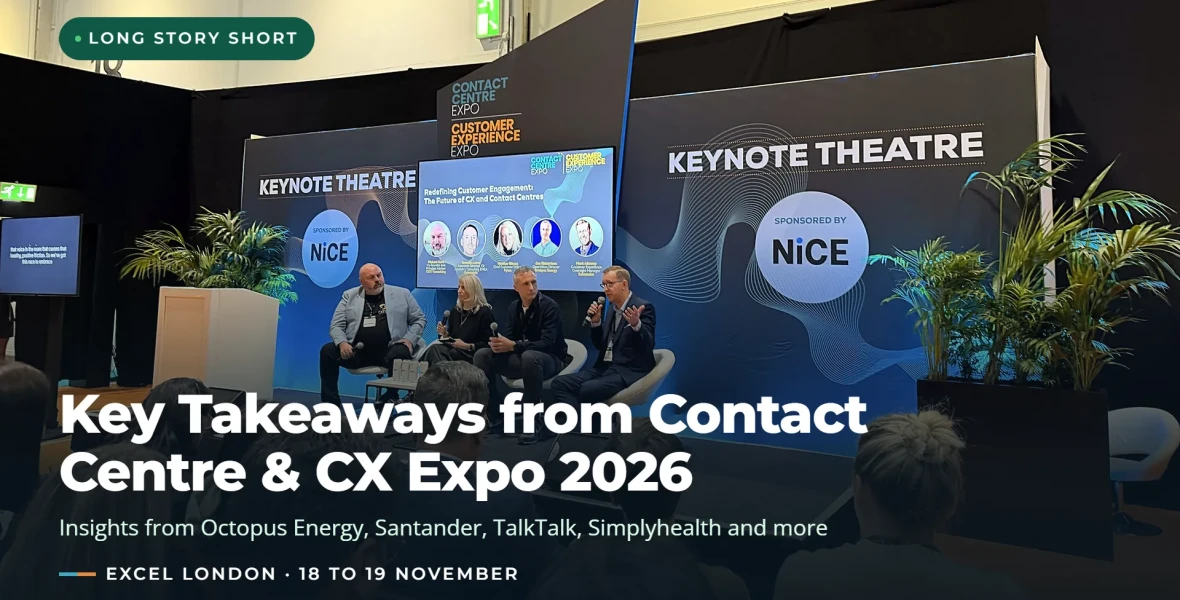
This week, we've been at the Customer Experience and Contact Centre Expo at ExCeL London, hearing how some of the UK's best-known organisations are using AI to improve customer support and CX. We've pulled together the key takeaways for CX professionals who couldn't attend: what those organisations are doing, what they are deliberately not doing, the mistakes they have learned from, and what they expect next.
In keeping with Long Story Short, we have distilled seven sessions into the points most worth your time.
Key Points
AI behind the scenes in Customer Service is now standard: transcription, summaries, drafted replies, sentiment and real-time quality scoring.
Customer-facing AI is growing, but carefully: narrow use cases first, with an easy route to a person.
AI is only as good as the information it reads. Out-of-date content is a common point of failure.
With routine work supported by AI, human agents handle the harder conversations. They need better tools, training, trust and recognition.
The next shift is customers' own AI agents contacting you on their behalf.
The organisations doing best are obsessed with customer experience, and measure success in satisfaction, not cost saved.
Why VCG Attends
Events like this keep us current on how customer service is changing. We hear from organisations beyond our own customer base and the people who run their contact centres, test our thinking against theirs, and spend time with customers and the CX vendors we work with.
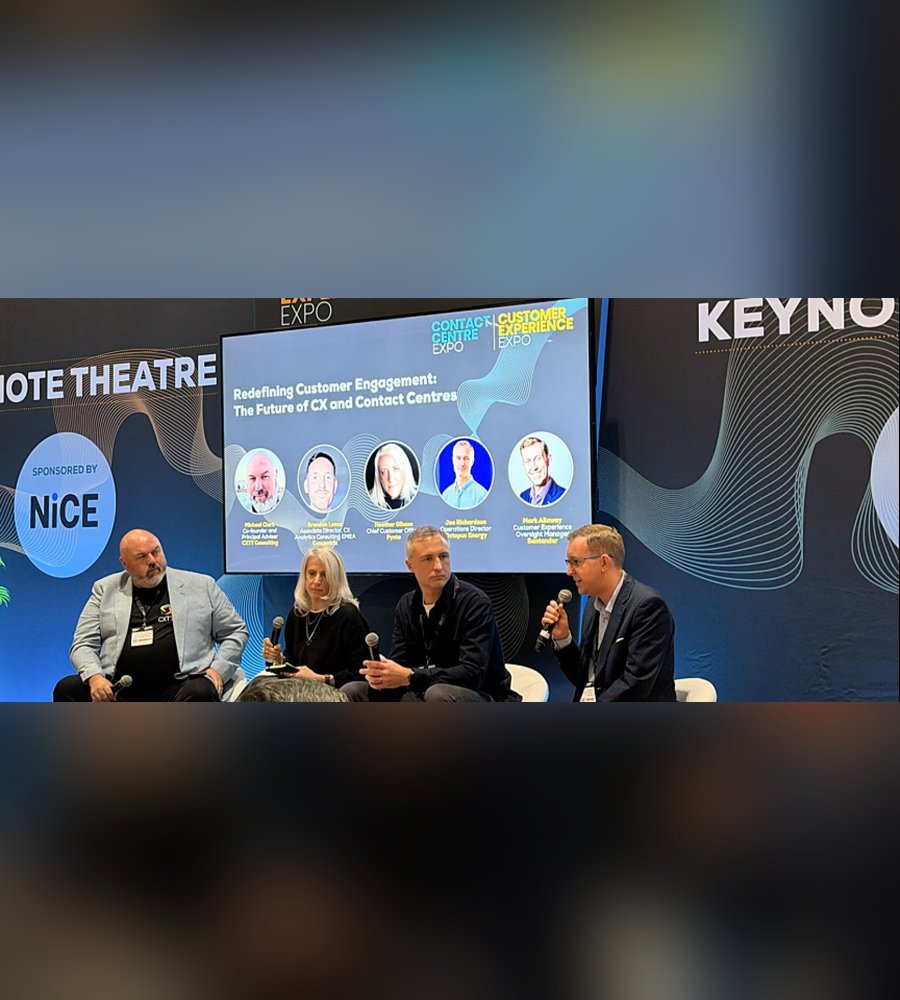
This summary draws on seven sessions, with speakers from Octopus Energy, Santander, TalkTalk, Worcester Bosch, the London Borough of Camden, Simplyhealth, Adanola and Mojo Mortgages, alongside NiCE, Five9, Talkative and Salesforce.
AI Behind the Scenes
Nearly every organisation we heard from uses AI to support its customer service teams, whatever its view on customer-facing AI.
Octopus Energy transcribes and summarises every call, gives specialists an AI-written history of each account, and uses AI to help draft or improve email replies.
Simplyhealth attaches call transcripts straight to the case, so agents no longer type up notes.
TalkTalk puts AI summaries of voice and chat conversations into its CRM and prompts specialists during calls. It has cut training time as a result.
Santander is building an insights platform that finds themes in open-text survey comments, work currently done by hand.
Quality and sentiment are assessed live: every conversation is scored, and sentiment analysis flags calls that are going badly so a manager can step in.
Teams see this as help, not a threat. It removes the searching, note-taking and routine replies nobody joined the job to do, surfaces trends worth acting on, and makes it easier for managers to support people on difficult calls.
Customer-Facing AI
Organisations are cautious about putting AI between themselves and their customers. Most do it to some degree; the difference is how far they go and how they do it.
Octopus Energy turned down a proposal for a general chatbot, as the need for one barely features in customer feedback. It started instead with email, which runs at around 400,000 messages a week, aiming to answer about 2% of them with AI. Staff reviewed every AI reply and stepped in when one was wrong, often because the AI had drawn on out-of-date material. Octopus is still experimenting.
Others are further on. Activewear brand Adanola automated 30% of its customer interactions within a month of going live and is working towards 50%. It began with order status updates and now handles parcel claims end to end.
The organisations doing this well share four habits:
They start small. High-volume, repetitive tasks come first. In Five9's research, 70% of consumers accept AI for password resets, but 60% want only a person for high-stakes issues.
They make a person easy to reach. In the same survey of 3,000 consumers, trust in AI to resolve an issue rose from 26% to 55% when a human option was available. Adanola stopped its AI trying to talk customers out of asking for a person.
They know when to step aside. Simplyhealth treats a mention of bereavement as a cue to offer a person straight away, and plans to use sentiment analysis from 2027 to spot frustration earlier.
They keep empathy human. One panellist's rule: AI belongs in the fridge, suited to work that is cold, processed and high volume. Once a conversation needs empathy, a person takes over. The London Borough of Camden handles everything from parking fines to children going into care, and those need very different handling.
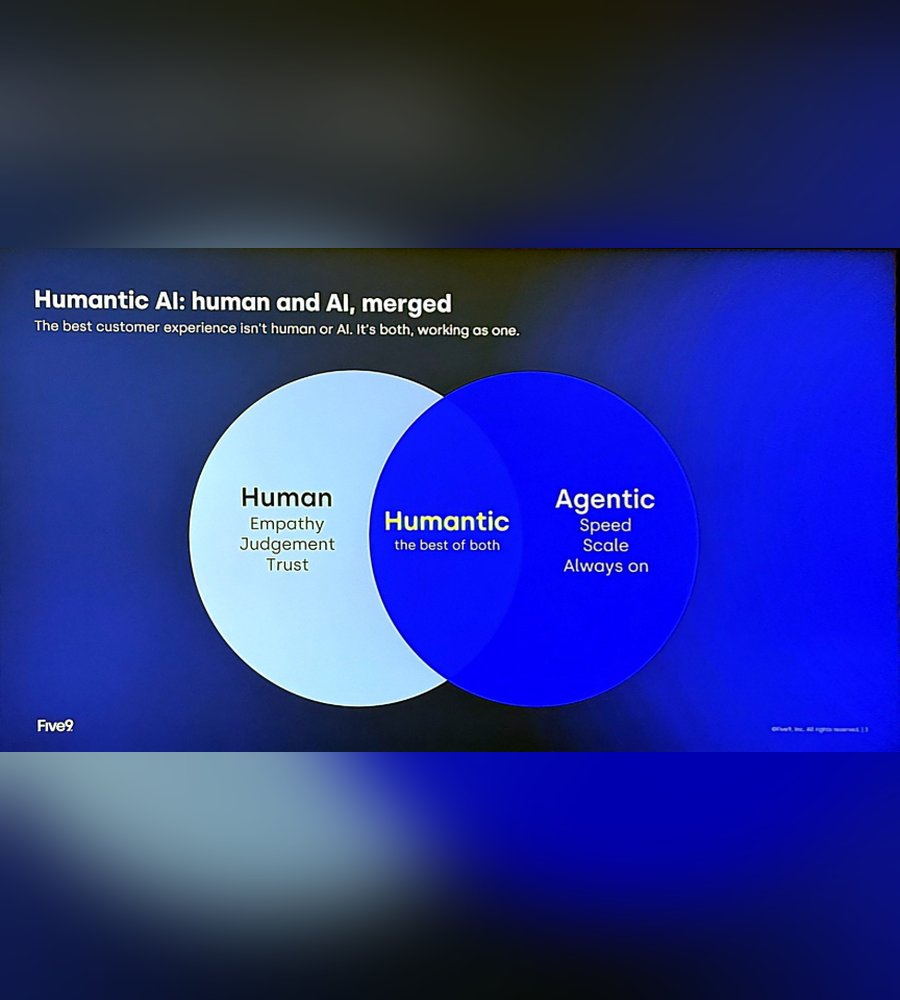
Five9 calls this blend "Humantic" AI: people bring empathy, judgement and trust, AI brings speed, scale and constant availability, and the best customer experience combines the two.
Comfort with AI varies. In Five9's research, 60% of baby boomers avoid AI where they can, against around 40% of Gen Z and millennials. Customer-facing AI has to work for everyone, from daily users of AI assistants to people who would rather not use them at all. Camden expected residents to reject AI; most were open to it and mainly wanted to know how their data would be used.
That balance is shifting quickly. The Reuters Institute found weekly use of AI chatbots rose from 34% to 51% in a year across the countries it tracks, and users say they rely less on search engines. NiCE argued that once people get used to simply asking AI, they expect the same ease from every organisation: an instant answer rather than a place in a queue. As personal AI use grows, more customers will be comfortable with AI service and better able to judge when they need a person. It also brings the next challenge, covered below: customers' own AI agents contacting customer service on their behalf.
What AI Means for Contact Centre Teams
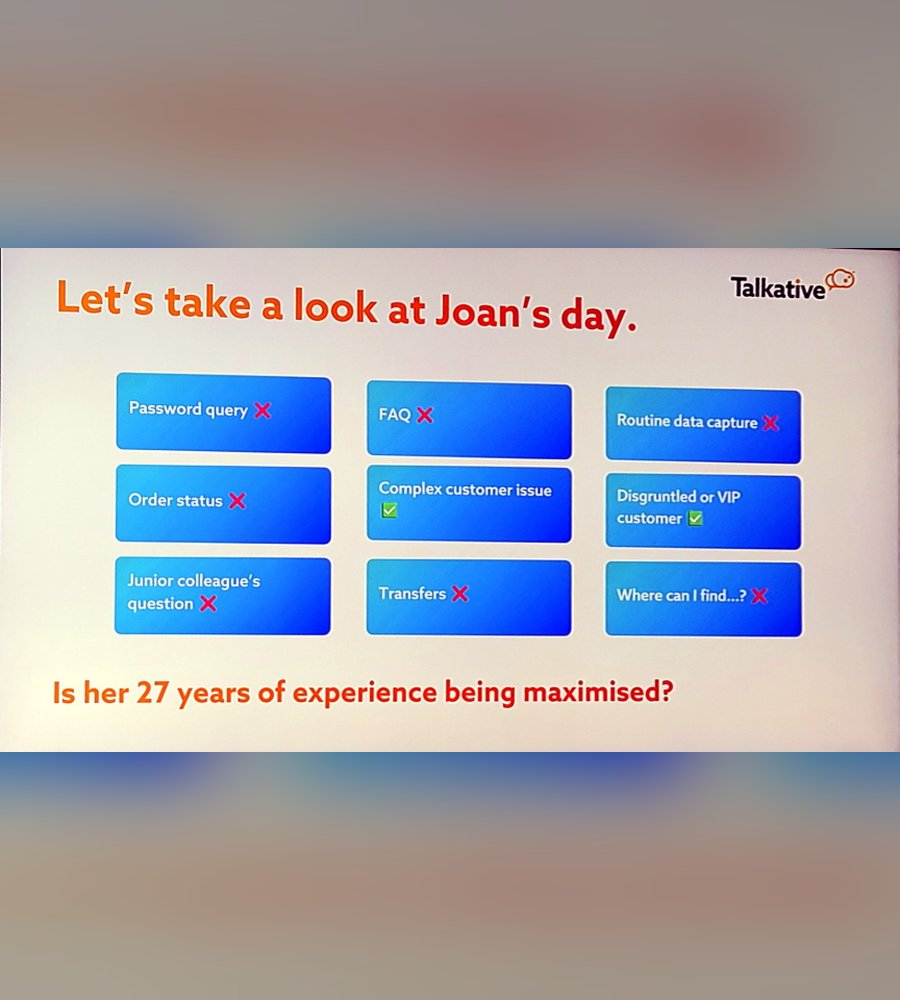
Talkative illustrated the challenge with two characters, Joan and Jack. They are deliberate stereotypes, and plenty of people fit neither, but they make the point.
Joan has worked in the contact centre for 27 years. She has seen every kind of case, knows the products and processes inside out, and is who you want when something goes wrong. She can be wary of new technology or anything that changes her well-honed ways of working; when leadership promotes AI, she is rarely the first to take it up. Yet her day fills up with password queries, FAQs, order status checks and questions from junior colleagues, so her experience is under-used and she is constantly under pressure.
Jack joined 27 days ago. He is enthusiastic, comfortable with modern tools and keen to try anything new, but he does not yet know the answers. When he puts a customer on hold, it is Joan he messages.
AI helps both. It takes routine work off Joan, so her experience goes on complex and VIP customers. It gives Jack the right answer during the call, so he leans on Joan less and customers get the same outcome whoever answers. Talkative's advice was to involve Joan from the start: ask what she does every day that she should not have to, what everyone comes to her for, and which conversations need her experience. She is won over by seeing the benefit in her own day, not by being told to use AI.
This change has a cost. With the easy conversations automated, human agents go from one complex or emotional conversation to the next, with no simple calls in between to recover. Mojo Mortgages saw compliance dip as cognitive load rose and is reviewing how many appointments each adviser takes. Camden is looking at time away from the phones, and Worcester Bosch has introduced a career framework so advisers can progress. Simplyhealth's Paul Cuglietta no longer looks at average handling time and wants base salaries to rise as the work becomes more complex.
Speakers also called for more trust in frontline teams. The aim is fewer scripts and more natural, flexible conversations, made possible because AI puts the right information and prompts in front of the agent during the call. That needs investment in people as well as tools: Octopus Energy expects technical knowledge, negotiation and de-escalation to matter more, and Mojo Mortgages uses AI role play so advisers can practise in private, lifting conversion on some leads by 12%.
Data, Governance and Guardrails
AI is only as good as the information it reads. Octopus Energy's AI quoted prices from old marketing blogs, so marketing now helps keep that content current. Product descriptions, FAQs, knowledge bases and courier tracking data all feed the AI, which makes content quality a business-wide job, not one for customer service alone.
Governance came up in most sessions. The practical points:
Ask customers first. Santander's Mark Allaway urged testing whether customers are comfortable with AI before rolling it out. Customers who quietly leave push up the cost of serving those who stay, wiping out the savings.
Treat AI like Jack, not Joan. One panellist called it an intern on speed: onboard it, train it, start it on simple work and check what it does.
Catch outliers. An Australian brand's AI told subscribers their price had risen 400%, then insisted it was right when customers challenged it.
Watch for summary drift. Camden's Phil Quickenden warned that one AI summary can feed another system, which summarises it again, until the customer's own words and sentiment are lost.
Read AI quality flags in context. Five9 warned that scoring every interaction will raise red flags, some against strong performers, that need a manager's judgement.
Handoffs, IVR and Joined-Up Systems
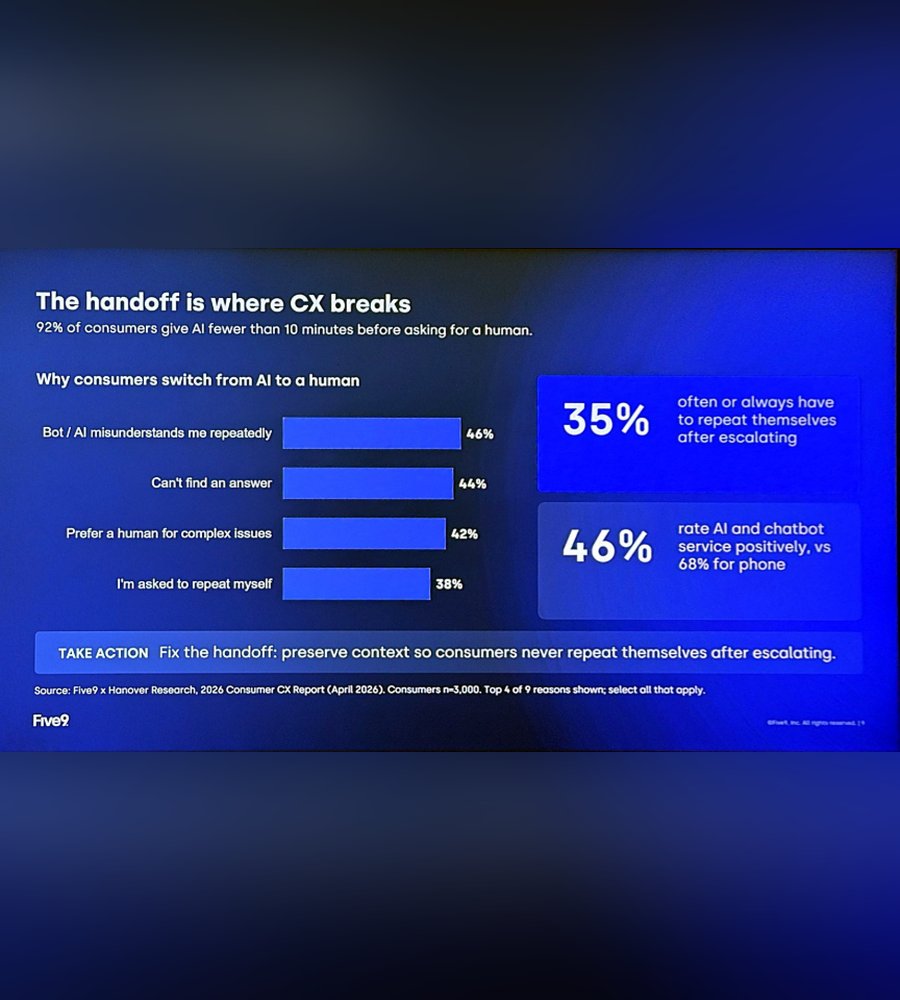
Five9 called the handoff from automated service to a person the point where CX currently breaks. Its presenter described calling his bank: he explained his problem to the automated IVR, again to an agent, and a third time to the fraud team when he finally reached the right place. Salesforce cited research that 83% of consumers repeat information to a human agent after being transferred from an AI bot.
Some causes are structural. Traditional IVRs mirror an organisation's structure, not what the customer needs. Systems are siloed, so security checks and details captured in one step do not reach the next, and agents switch between four to six disconnected applications to resolve basic cases.
Others come down to quality. If the AI is not capable enough, misreads the customer or works from the wrong material, customers give up on it. In Five9's research, 92% give AI less than 10 minutes before asking for a person, and the top reasons for switching were being misunderstood repeatedly (46%), not finding an answer (44%) and preferring a person for complex issues (42%).
The answer most vendors offered is orchestration: AI agents, human agents, knowledge and customer data working from one platform, so context follows the customer across channels and teams. Done well, AI identifies the issue, verifies the customer, routes them to the right team and passes on the full conversation. Doctor Care Anywhere now resolves over 70% of calls first time after adding smarter routing and CRM integration, and employee satisfaction rose 44 points.
TalkTalk is changing its operating model too. Multi-skilled specialists own a group of customers end to end, without transfers, with AI making that breadth of knowledge manageable.
AI-Written Complaints
Customers are already using AI to write complaints. Camden has seen complaint volumes climb, and Worcester Bosch reports AI-written complaints running to three or four pages, more detailed and slower to answer. Replying with AI risks long AI-to-AI email chains, so some teams pick up the phone instead, which often resolves things faster.
Customers' Own AI Agents
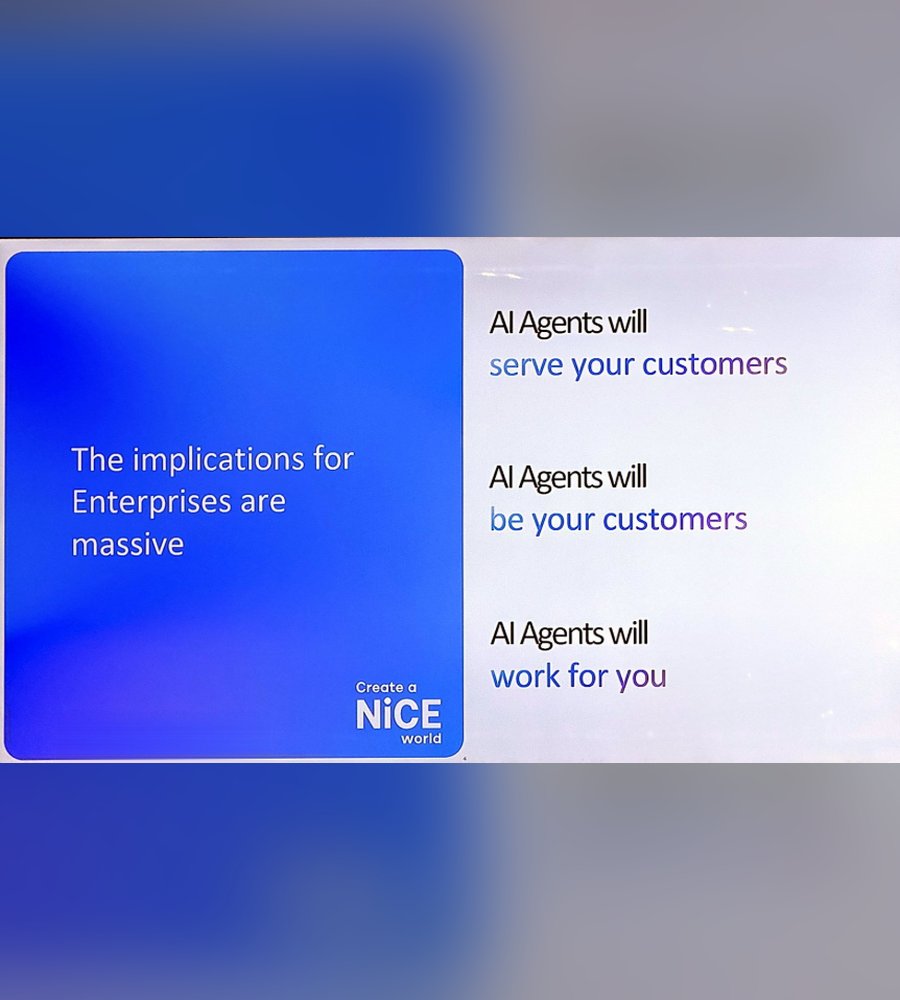
The next concern for many CX leaders is not their own AI but their customers'. NiCE put it in three lines: AI agents will serve your customers, AI agents will be your customers, and AI agents will work for you.
Consumer agents are already here. Since 12 November, Meta's Muse can phone US businesses on its user's behalf, from cable companies to restaurants. OpenAI launched its dots agents in September, able to reschedule appointments and book flights.
One speaker sent a customer-side AI agent to call contact centres. It passed verification and explained the fault, and some advisers did not realise they were speaking to AI. Set against a company's own AI agent, the two solved the problem but struggled with device details.
AI Assistants as a Customer Service Channel
Looking further ahead, we expect AI assistants such as ChatGPT, Claude and Gemini to become customer service channels in their own right, much as WhatsApp has. Picture telling your assistant you have changed your mind about something you ordered from Amazon last week. It replies at once: "No problem. I've created an Evri returns label, as I know you prefer the drop-off point round the corner, and logged the return with Amazon. It needs to go back within two weeks; shall I set a reminder?" No login or security questions, because it already knows it's you, and no queue.
The real difficulty will come during the transition, when customer and company AI agents meet on channels built for people. Customers' AI agents will ring support lines and wait in queues, talk to support AI agents, and email inboxes that AI monitors and answers. Contact centres will need to recognise AI-initiated contacts, keep verification and safety controls in place, decide when a person steps in, and consider giving AI agents a more direct route than queues designed for people.
Measuring Success
The organisations getting this right are obsessed with their customers. They start with what the customer needs, work backwards, and judge AI by customer satisfaction rather than cost saved; projects run purely to cut costs tend to struggle. NiCE's customers using AI agents see over 90% call containment and handling times cut by more than 25%, but NiCE called the 20%+ rise in CSAT the real reason to do it. Bugaboo, working with Talkative, focused an AI assistant on product comparisons. It now contains 75% of conversations, and customers who use it spend 35% more.
Speakers suggested practical changes to metrics:
Track customers served per day across all channels, rather than average handling time.
Add customer effort score.
Split CSAT between the AI journey and the agent, so a good agent does not hide a poor AI experience.
Ask the team about time saved, backlogs and how the work feels.
How VCG Can Help
VCG has designed, installed and managed contact centre and business voice solutions for more than 20 years, for organisations including Welcome Break, Big Yellow Self Storage, JLL, LUSH and the British Heart Foundation. We build on leading platforms from RingCentral, Zoom and 8x8, and stay vendor-neutral so the platform fits your operation.
Our CX solutions reflect what we heard at the expo:
AI to support customer service teams: live sentiment, suggested responses and summaries, with managers prompted to step in during the call.
CX insight: every conversation scored and summarised, so experience is managed on evidence.
AI self-service and virtual agents: trained on your knowledge, and handing over to a person with the full story attached.
AI telephony: cloud voice and an AI receptionist for multi-site organisations, where customers call the store or branch.
Omnichannel engagement: phone, web chat, WhatsApp, social and email in one console, with context that follows the customer.
We start with a CX Discovery, a review of your customer experience that leaves you with a scorecard, quick wins and a prioritised roadmap. Through VCG Care, we can then run and tune the platform for its whole life.
If you're looking to capitalise on AI in your customer service team, our experts can help guide you in the right direction. Email info@vcg.group or call 0161 406 1820, or read our CX solutions brochure [link to follow].
Further reading
Generative AI and News Report 2026: From standalone tools to information infrastructure, Reuters Institute, 29 October 2026
Muse can now place calls to US businesses, if you pay, TechCrunch, 12 November 2026
OpenAI launches dots, The San Francisco Standard, 29 September 2026
Five9 x Hanover Research, 2026 Consumer CX Report (April 2026), as presented by Five9 at the expo